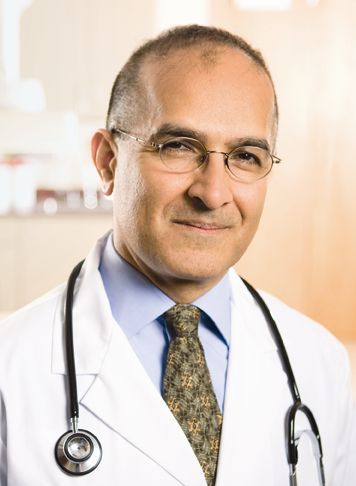
Dr. Naqvi has worked for Community Hospital Anderson since 2007 in the Diabetes Care Center. Dr. Naqvi says when it comes to why she became a doctor, it was due to her intense desire to serve and help her fellow human beings alleviate their suffering from diseases.
Dr. Naqvi believes that clinical research is incredibly important to the advancements of medicine, stating “clinical research is vital to continuing the movement forward and finding new and better medicine to treat different diseases.”
She also believes there are infinite benefits to participating in clinical research. Patients are able to get new and innovative medicine while participating and helping to find new alternatives for others as well. She adds that “[Patients] think they are being used as guinea pigs which is untrue.” Research studies are highly regulated by the FDA and patients are constantly monitored.
When Dr. Naqvi had free time in medical school, she enjoyed playing ping pong and received the “Best Player Award”.
CCRC would like to thank Dr. Afia Naqvi for her hard work and dedication to medicine and clinical research!
At Community Hospital Anderson Clinical Research Center (CCRC), we work daily on helping doctors and patients find the newest and most cutting edge solutions to their medical issues. Our studies are always changing and this is a place to keep you updated on what is going on at CCRC including external medical advances along with information about our current and upcoming studies. Thanks for checking us out and feel free to contact us anytime!!
Friday, December 3, 2010
Investigator of the Month: Dr. Afia Naqvi
Wednesday, November 3, 2010
Sheri Lantz
Nurse Practitioner
Sheri Lantz, a family nurse practitioner at Healthy Hearts, has always known that nursing was in her blood. Deciding on a career was never a difficult decision for her to make.
When Sheri is not working in Healthy Hearts, you can find her in the emergency room on the weekends as an RN and at the Ball State Student Health Clinic on Tuesdays as one of their NPs. As a sub-investigator for cardiac clinical trials under Dr. Jetty and migraine studies under Dr. Blankenship, Lantz performs study-related medical exams.
Lantz sees her participation in clinical research as a great opportunity to create and test new medicines that can help her patients as well as patients on a broader scale. She enjoys listening to people’s life stories and making a difference in their lives. Her goal is to help improve the patient’s overall wellness and quality of life.
CCRC would like to thank Sheri for her hard work and dedication to medicine and clinical research.
Wednesday, September 15, 2010
A link from type 2 diabetes to alzheimer's?
An interesting article from the American Diabetes Association on the possible link from type 2 diabetes that can lead to alzheimer's and whats being done to prevent this.
http://forecast.diabetes.org/magazine/your-ada/does-type-2-care-bolster-brain-function?utm_source=Homepage&utm_medium=ContentPage&utm_content=DFContents&utm_campaign=DF
Friday, September 10, 2010
Physician of the Month
A native of Anderson, Dr. Maier returned to his hometown upon completion of his medical education at Indiana University and training. He currently practices gastroenterology at Central Indiana Gastroenterology Group. In addition, Dr. Maier is affiliated with several area hospitals, including Community Hospital Anderson as well as Community Clinical Research Center, where he oversees studies relating to gastroenterology.
Dr. Maier’s interest in the medical profession began in his early teens when his mother was being treated for breast cancer. Spending a lot of time in hospitals and around doctors, led him to develop an interest in the field. As a result, Dr. Maier knew by the age of 12 or 13 that he wanted to become a doctor.
Having always enjoyed research, Dr. Maier sees his involvement with CCRC and clinical research as the best opportunity to continue helping people in ways that are not yet available to the public. Always looking for new ways to help people, clinical research provides him with the opportunity to help those who want and need help. He admits patients of clinical trials are sometimes put into tough positions. They often do not know which study medications they are testing. Dr. Maier knows that patients, like him, are always looking for better and easier treatments for their conditions. Clinical trials allow those people to take action, becoming active in their own treatment as well as the treatments of other patients.
Aside from his many professional activities, Dr. Maier also enjoys working in the garden, especially with flowers. He does his own landscaping, saying that he enjoys digging around in the dirt. He also continues his childhood enjoyment of sports, still playing golf.
CCRC would like to thank Dr. Maier for his hard work and dedication to medicine and clinical research.
Wednesday, August 25, 2010
Physician Spotlight - Dr. Jetty
![]() |
| Preetham Jetty, M.D., F.R.C.P. |
Dr. Jetty completed his initial medical education in India. However, seeing the U.S. as the country with the greatest opportunity for anyone who wants to work hard and be the best they can be, he came to the U.S. for the remainder of his education and training. Dr. Jetty began his work in Anderson in 1998 as a cardiologist for Indiana Heart Associates before working with Heart Partners of Indiana, LLC. He started the Jetty Heart Clinic in 2008, which he currently runs in addition to being the Chief of the Department of Cardiology at Community Hospital Anderson.
In 2005, Dr. Jetty partnered with CCRC as a principal investigator for trials studying cardiac conditions such as ACS and atrial fibrillation. Dr. Jetty sees his involvement in clinical research as a way to stay in contact with patients while still staying ahead of the ever-evolving field of medicine. By taking part in clinical research, Jetty gets to see new medicines come to fruition, eventually bringing them into practice. In addition, access to the research community allows for a flow of ideas and information between the country’s leading physicians.
According to Dr. Jetty, the rewards of clinical research do not stop with the physicians involved. The people who take part in clinical trials allow for the great life-saving medicines and treatments that we have today. Dr. Jetty believes that if we had the perfect medicine for you, we would not need research, but physicians and others in the medical field are always looking for better treatments. Participants in clinical trials receive first-rate medical care. Trials follow highly regulated practices and are done with the knowledge that current treatments are inadequate and can be improved upon. Patient safety is the number one priority in all clinical research. Monitoring of patients is held to a much higher standard than in typical treatment situations and patients are always free to choose whether or not they want to participate in a study.
Despite his position as one of the area’s leading and busiest cardiologists, Dr. Jetty is an avid concertgoer, attending shows all over the country. A fan of alternative music, the last show he attended was a Modest Mouse concert in St. Louis. An escape from his busy life, Dr. Jetty finds music to be calming to his sense.
CCRC would like to thank Dr. Jetty for his hard work and dedication to medicine and clinical research.
Wednesday, August 18, 2010
Evolution of U.S. Drug Laws - Food and Drug Act of 1906/ Nuremberg Code
Food and Drug Act of 1906
- First comprehensive U.S. drug law
- Followed the 1905 release of a book by Upton Sinclair called "The Jungle", which exposed the unsanitary conditions of Chicago's meat-packing industry and led to legislation requiring processing inspections and forbidding interstate and foreign commerce in both impure and mislabeled food and drugs
- Did not require drugs to be effective, but it did require "that drugs meet standards of strength and purity. The burden of proof was on FDA to show that a drug's labeling was false and fraudulent before it could be taken off the market." - quoted from www.fda.gov.
- Prior to 1907, medications were bought and sold like any other good. There was no requirement to reveal the ingredients of a drug.
- In 1938, as a result of 107 deaths from "Elixir Sulfanilmade", the FDA was able to require drug manufacturers to prove the safety of a drug before it could be sold to the public.
- Formed in 1947 in response to Nazi abuses of prisoners during World War II
- First international ethical guidelines for clinical research
- Required that volunteers provide informed consent prior to participating in experiments and that the benefits of the research be weighed against the risks and discomforts of the patients
Labels:
Evolution of U.S. Drug Laws
Wednesday, August 4, 2010
Evolution of U.S. Drug Laws - Vaccine Act of 1813/ Import Drug Acts of 1848
Vaccine Act of 1813
- First federal law concerning consumer protection and medicinal substances.
- Smallpox epidemics were a common occurrence throughout the 1700s and 1800s.
- Efforts were made to develop a vaccine for smallpox from cowpox scabs imported from England.
- The cowpox virus could not live very long in dried scabs.
- As a result, the virus was transmitted by arm-to-arm contact in successive person-to person inoculations.
- This means that an infected vaccination lesion on one person was scraped and used as material to inoculate the next person.
- This method is no longer used, as other infectious diseases were often transmitted along with the cowpox vaccine.
- The Vaccine Act mandated that a purer supply of the cowpox be sustained and be given to any citizen.
- Dr. James Smith was named as the first vaccine agent.
- He had 20 years of experience in the transmission of the cowpox vaccine through arm-to-arm contact every 8 days.
- However, in 1821 he accidentally sent smallpox crusts instead of the cowpox vaccine to North Carolina.
- The inoculation of patients with live smallpox led to a smallpox epidemic as well as the repeal of the Vaccine Act of 1813.
Import Drug Act of 1848
- Established customs laboratories
- Responded to counterfeit, contaminated or adulterated drugs being transported into the U.S.
- Prior to the passing of the act, American troops in Mexico had received counterfeit and ineffective medicines for malaria.
Labels:
Evolution of U.S. Drug Laws
Subscribe to:
Posts (Atom)